How to Respond to Negative Reviews: Complete Guide
Learn how to respond to negative reviews professionally. 5 principles, concrete examples, and templates to transform criticism into opportunities.

How to Respond to Negative Reviews: Complete Guide
A negative review stings. That uncomfortable feeling when you discover a one-star rating and a scathing comment about your business — every owner has experienced it.
Here's the good news: how you respond often matters more than the review itself. A well-crafted response can transform a difficult moment into a demonstration of professionalism. A poor response, on the other hand, can amplify the damage.
This guide covers the principles, techniques, and mistakes to avoid when handling negative reviews.
Why Respond to Negative Reviews?
Before addressing the "how," let's clarify the "why."
Potential customers read your responses
Research consistently shows that over 90% of consumers read business responses to reviews. Your response speaks less to the unhappy customer and more to the dozens of prospects evaluating your professionalism.
A calm, constructive response reassures. No response — or worse, an aggressive one — raises concerns.
The SEO impact
Google considers engagement with reviews as a quality signal. Responding regularly, including to negative reviews, contributes positively to your local visibility.
The recovery opportunity
An unhappy customer who receives a thoughtful response may update their review. This doesn't happen every time, but it occurs more often than you'd expect — provided the response is genuine and the problem is actually addressed.
The 5 Principles of a Good Response

1. Respond quickly (but not hastily)
The ideal: respond within 24 to 48 hours. Fast enough to demonstrate responsiveness, slow enough to have gained emotional distance.
Responding in the heat of frustration rarely produces good results. If a review particularly affects you, wait a few hours before writing.
2. Thank first
Counterintuitive but effective: begin by thanking the customer for their feedback. Even a negative review represents time invested to give you input.
This opening disarms and immediately positions your response as constructive rather than defensive.
3. Acknowledge the problem
The customer had an experience they perceived as negative. Whether you agree with their perception or not, that experience is real to them.
Acknowledging the inconvenience isn't admitting fault. It's simply showing that you heard and understood.
4. Explain without making excuses
There's a subtle but important difference between explaining and making excuses.
Making excuses (avoid): "That day we were understaffed due to sick calls, and our supplier delivered late, so..."
Explaining (acceptable): "We identified an organizational issue that day which we've since corrected."
Excuses sound defensive. Explanations show awareness and action.
5. Offer a next step
End with an opening: invitation to return, offer of direct contact, resolution proposal. This next step depends on the context and severity of the issue raised.
Structure of an Effective Response
Here's a four-part structure that works in most situations:
1. Thank + Personalize
   "Hi [Name], thank you for taking the time to share your experience."

2. Acknowledge the problem
   "I understand your disappointment regarding [specific issue mentioned]."

3. Response/Action
   "We've [action taken] to prevent this from happening again."
   OR "I'd love to discuss this with you to better understand what happened."

4. Opening
   "Please feel free to contact me directly at [email/phone] if you'd like to talk."
   OR "We hope to have the opportunity to welcome you again."
This structure isn't rigid. Adapt it based on context, severity, and the tone of the original review.
Concrete Examples by Situation
Situation 1: Service problem (wait time, staff attitude)
The review:
"Endless wait, 45 minutes to be served. The waiter seemed overwhelmed and unfriendly. Disappointing."
Poor response:
"We were fully booked that evening and understaffed. 45 minutes is exaggerated — our records show 25 minutes maximum."
Good response:
"Hi Sarah, thank you for your feedback. Your wait that evening was clearly unacceptable, and I understand your frustration. We've revised our staffing for busy periods. I sincerely hope you'll give us another chance to show you service that meets our usual standards."
Why it works: No dispute over the 45 minutes (even if possibly exaggerated), clear acknowledgment of the problem, corrective action mentioned, invitation to return without pressure.
Situation 2: Product quality issue
The review:
"Pizza arrived cold and the dough was undercooked. Unacceptable for the price."
Poor response:
"We use fresh ingredients and our pizzas are wood-fired. Perhaps you ordered during a rush period?"
Good response:
"Hi Mike, I'm truly sorry for this experience. A cold, undercooked pizza isn't what we want to serve our customers. I'd appreciate if you could contact us at hello@restaurant.com so we can understand what went wrong and offer you a better experience. Thank you for letting us know."
Why it works: Sincere apology, no minimizing, concrete resolution offer, thanks for the feedback.
Situation 3: Unfair or exaggerated review
The review:
"SCAM! Ridiculous prices for mediocre quality. Avoid at all costs!!!"
Poor response:
"Your review is defamatory. Our prices are displayed and our quality is recognized. We reserve the right to take legal action."
Good response:
"Hi, I'm surprised by your feedback as we place great importance on price transparency and service quality. I'd genuinely like to understand what led to this disappointment. Could you contact me at manager@business.com? I commit to responding personally."
Why it works: No counter-attack despite the aggressive tone, expressing surprise rather than defense, openness to dialogue, positioning as a reasonable party (which contrasts with the review's tone).
Situation 4: Vague review with no details
The review:
"Meh. Not great. Won't be back."
Poor response:
"Can you specify what you didn't like? Hard to improve without details."
Good response:
"Hi, I'm sorry your experience didn't meet your expectations. If you'd like to share more details, I'd genuinely appreciate understanding what we could improve. Either way, thank you for taking the time to leave your feedback."
Why it works: No passive-aggressive tone ("hard to improve"), open invitation without pressure, gratitude despite the minimal content.
Situation 5: Legitimate and serious problem
The review:
"Found a hair in my food. When I pointed it out, the manager said it happens and offered nothing. Questionable hygiene and nonexistent customer service."
Response:
"Hi Jennifer, I sincerely apologize. What you describe is unacceptable — both the hygiene issue and our team's response. I've personally reviewed procedures with all staff, and this situation has led to immediate corrective measures. I'd like to contact you directly to apologize and offer compensation. Could you email me at owner@restaurant.com? I commit to responding within 24 hours."
Why it works: Unreserved apology, acknowledgment of the double failure (hygiene + reaction), concrete actions mentioned, compensation offer, personal commitment from management.
Fatal Mistakes to Avoid
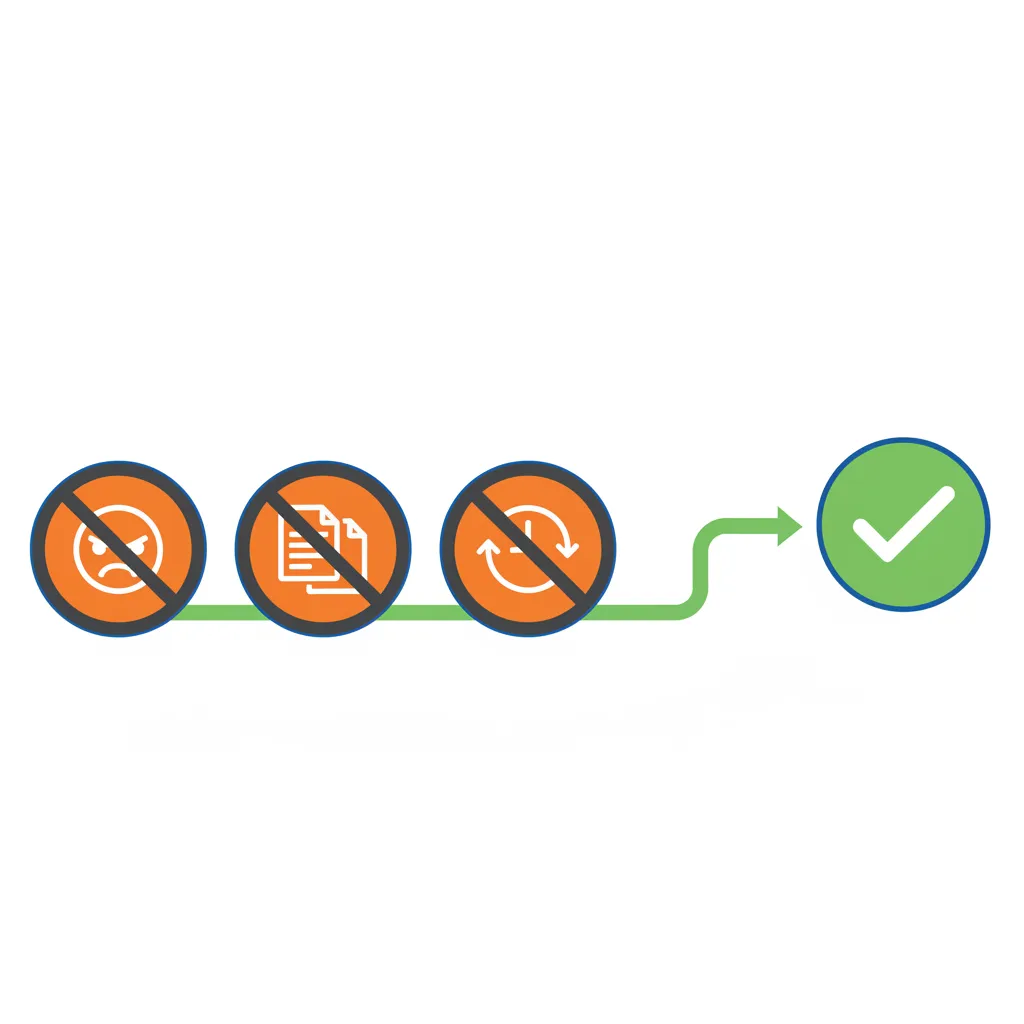
Mistake 1: Disputing the facts
Even if the customer exaggerates or is mistaken, publicly challenging their version creates confrontation. Readers of the exchange will often side with the "small" customer against the "big" business.
Avoid: "Our cameras show you were here 20 minutes, not an hour."
Mistake 2: The passive-aggressive tone
This tone is easily detectable and creates a very negative impression.
Avoid: "We're sorry your experience didn't meet your very high expectations."
Mistake 3: Generic copy-paste responses
An identical response to all negative reviews shows complete disinterest. Customers notice, and so do prospects.
Avoid: "Thank you for your feedback. We note your comments to improve."
Mistake 4: Complete silence
Not responding to a negative review leaves the last word to the unhappy customer. Prospects see a problem without a solution, a business that doesn't care about feedback.
Mistake 5: Responding emotionally
The response written at 11 PM after a tough day, driven by frustration, is rarely the right one. Wait. Reread. Have someone else read it if possible.
Special Cases
Obviously fake or competitor reviews
If you're certain a review comes from a competitor or someone who was never a customer:
- Report the review to Google through your Google Business Profile
- Respond factually: "We have no record of your visit to our establishment. If you did visit, please contact us so we can verify."
- Don't directly accuse them of posting a fake review — this can backfire
Google rarely removes reviews, but reporting remains important.
Reviews with personal information or defamation
Some reviews cross a line: insults, serious accusations, disclosure of personal information. In these cases:
- Report immediately to Google with specific reasons
- Respond briefly and professionally without engaging in the controversy
- Consult a lawyer if accusations are serious and false
Unhappy regular customer
A loyal customer who suddenly leaves a negative review deserves special attention. Contact them privately before even responding publicly. The existing relationship often allows you to resolve the issue and obtain a review modification.
Turning Negative into Positive
Negative reviews, as unpleasant as they are, offer opportunities:
Free feedback: Your customers tell you what's not working. This information has value.
Professionalism demonstration: An exemplary response to a difficult review impresses more than yet another 5-star review.
Credibility: A profile with only perfect reviews looks suspicious. A few well-managed negative reviews reinforce authenticity.
Continuous improvement: Patterns in negative reviews reveal the real weaknesses in your business.
Automate Without Losing the Human Touch
Responding to each review individually takes time. Tools exist to speed up the process without losing personalization.
ReplyStack generates personalized responses via a Chrome extension that works directly on Google Business Profile. The AI considers the review content and your "Response Profile" (tone, key messages, signature) to propose an adapted response.
The advantage: you stay on your Google listing, one click generates a proposal, you validate or adjust, you publish. Time per response drops from 5-10 minutes to under a minute, while maintaining personalization.
→ Try ReplyStack free — 15 AI responses/month, no commitment
Pre-Publication Checklist
Before publishing your response, verify:
- Did I wait long enough to avoid responding emotionally?
- Did I thank the customer for their feedback?
- Did I acknowledge the problem without over-justifying?
- Is my response personalized (name, specific details)?
- Is my tone professional and non-defensive?
- Did I offer a next step (contact, invitation)?
- Would my response be convincing if I were a prospect reading it?
- Did I read it aloud to detect any passive-aggressive tone?
Conclusion
Responding to negative reviews is never pleasant. But it's a skill that develops and has real impact on your reputation.
The principles are simple: thank, acknowledge, explain without making excuses, offer a next step. Execution requires emotional distance and practice.
Every negative review is an opportunity to show who you really are — not in easy moments, but in difficult ones. That's where trust is built.
Need help responding to reviews more efficiently?
ReplyStack generates personalized responses in one click, directly on Google. Try it free.
Related articles: Review Response Templates • Best Review Management Software 2026
ReplyStack Team
Review Management Experts